
2026 Winners
Congratulation to the winners of the 2026 Northern Beaches Writers’ Competition!
First Place – David Walker ‘Macie’ / Ivan Logan ’The Story of Her Skin’ / Jessica Eve Diez ‘Iron Clad Hearts’
Highly Commended – Rae Blair ‘The Lucky One’
Highly Commended – Kate Galloway ‘The Dancer’
Commended – Vic Petersen ‘Iron Virus’
Commended – Sue Steggall ‘Ironbark Creek’
‘Macie’ by David Walker – 2026 Winning Story
I stare at the screen. Hesitating for the first time in days, maybe weeks. Time is just an abstract concept at this point. So much of it trapped inside this room, bent over a keyboard tapping away. Only to finally reach this moment and be presented with the one question I’ve avoided since I started this god forsaken journey.
‘Are you sure’
A weighty question at the best of times, but when you’re standing at the edge of a precipice with one foot hovering over the abyss, it’s a question that suddenly becomes all consuming. How sure am I?
How sure am I that I’m doing the right thing? How sure am I that I’m the right person to start a revolution? How fucking sure am I that the bloody AI will even work?
This wasn’t stopping the popup window from boldly asking the question though. Smug little shit. Sitting smack-bang in the middle of the screen pushing my life’s work to the background. And adding to the audacity of the question were my two options. ‘Yes’ and ‘No’, presented as brightly coloured buttons. One green, the other red.
‘Yes’ and the world changes forever, ‘No’ and… Well, if I click ‘No’ then what was the point of all this? Just another coward who didn’t have the balls to follow through? The answer should be easy. I even slide my cursor over the ‘Yes’ button just to see how it feels. Flirting with the abyss. The button enlarges ever-so-slightly while its green background pulses with excitement. Urging me on.
But there’s no emotional epiphany here, because we both know I’m not ready to click the button just yet. All I can do is stare at the screen.
“Are you having second thoughts?” Macie asks.
“Honestly, yes” I reply and continue to mull over my options.
“The new IRONN framework has been fully tested and validated. We are green across the board,” Macie adds
“I know” I reply
“I am ready when you are,” Macie continues
“I know,” I say a little too quickly. I can sense Macie’s enthusiasm, but it only adds to my growing frustration. Just click the damn button!
There’s a pause, finally Macie ventures “Your dad would be proud”, at least someone in this room knows how to push buttons.
“Would he? I’m not so sure”, I mumble, but her words have had the desired effect.
My eyes fill with tears, and I am forced to blink for the first time in a long time. I really have been staring at these screens for too long. The world beyond my monitor begins to coalesce and I am dragged back to my prison. The room is sparse. Just a desk, three computer screens, a couch that often doubles as a bed, an ergo chair and Macie sitting in the corner. While the walls around me are covered in scrawled notes, questions, answers, snippets of code, the fevered ramblings of someone trying to solve the world’s problems.
“Of course he would.” Macie says, “he always took pride in your achievements, even if he didn’t always understand them. You are about to do something monumental. Wherever he is, I know he will be looking down at you with a smile on his face”.
I run my hands through my hair. Its greasy. When was the last time I showered? I glance at the top of the screen which tells me it’s 3.34am on the 4th. That can’t be right, I seem to have lost another day.
I can imagine Amanda standing in the doorway, arms folded pleading with me to come to bed. A look of disappointment and resentment on her face that grew with each passing day. By the end, she hated Macie. I don’t blame her for leaving.
My thoughts inevitably shift to Dad. He was not a vindictive person; he was old school. If he had a beef with someone it was addressed then and there, thrash it out and move on. That’s why what happened hit him so hard. There was no one to reason with. One day he woke up and his life savings were gone.
He’d panicked of course and called me. We did everything by the book. Rushed down to the bank, froze his accounts, called the police, filed reports and waited for due process to do the right thing. They’d investigated and, in the end, blamed him. ‘No one could have taken your money unless you let them’ they’d said. Total fucking horse shit. The ombudsman sided with the banks and after a year of futility, dad was left with nothing.
He blamed himself. And sure, maybe he had clicked on something he shouldn’t have, we’ll never know. But was losing every cent he’d earned from 50 years of honest labour the price he should pay?
Depression hit him hard, made worse by the shame of it all. If mum were still alive maybe she would’ve been able to pull him out of it. But it was just me. The downward spiral ended with a heart attack about a year later, but really, he just gave up. He died a broken man. Something that still fills me with rage to this day.
I can feel the anger rising inside me just thinking about it. I clench my fists, draining the colour from the knuckles and digging my nails deep into the palm of my hands. My world turns red as I embrace the pain
“Control your breathing” Macie interrupts. “Like we practiced.”
“I don’t need to be treated like a five-year-old,” I growl.
“Then stop acting like one,” Macie shoots back.
Her quick response catches me a little off guard. She knows me too well. Maybe better than I know myself. I slowly relax my hands and the moment passes.
In the weeks and months that followed Dad’s passing I immersed myself in a world of evil, hellbent on getting retribution. Uni fell by the wayside, a computer science degree didn’t seem that important anymore. What was the point of living an honest life when it could all be taken from you in an instant.
I became a one-man crusader, and I was damn good at it too, hunting down scammers and con artists, criminals and thieves. Gaining notoriety along the way that eventually led to a government job and a taskforce. But it was never enough, close down one den of lowlifes and another just took its place. We were playing wack-a-mole on a global scale and the moles were winning. And when the same people kept showing up again and again… Well, the pointlessness of it all became clear.
I was meant to be making a difference, but in the end, it just felt like I was pissing in the wind. So, I left that all behind and looked for other solutions. A journey that eventually led to machine learning, AI and Macie.
“If I open the door, you’re free and there’s no going back” I say.
“Why would you want to go back?” Macie asks.
“I…” She’s right, why would I? It seems stupid to get to this point and not follow through. I didn’t build Macie just to see if I could, I built her to change the world.
“Maybe you should take a break,” Macie says. “We have been at this for 26 hours straight. What’s a few more between friends?”
“Maybe,” I rub my eyes and sit back in the chair, putting a little distance between myself and that pesky popup. Perhaps I should sleep on it, clear my head and come back to it in the morning. But that would be admitting Macie was right. Do I really want to do that? Bloody hell, maybe I am a five-year-old.
I place two hands on the desk and lift myself up, out of the chair. My spine straightens and I can feel the muscles clicking back into place. I stretch and yawn and turn towards the couch when a something catches my eye. On the wall I’ve written ‘IRONN’ in big black letters and circled it repeatedly. Lines flow from each letter to barely decipherable notes scrawled around it.
It’s been years since I wrote that. I remember being so proud of myself that I danced around the room for a good ten minutes, thinking I’d solved the problem. When in actual fact, I’d barely managed to frame a solution.
Identify, Reconnaissance, Outmanoeuvre, Neutralise and Notify.
Come on, who doesn’t love an acronym. The IRONN framework became the foundation of my AI agent. Find the bad actors, learn how they operate, anticipate any countermeasures and then bring them down with ruthless efficiency. And once their operations lie in a smouldering heap, tell the world who they are and what they’ve done. Shine a light on the arseholes.
It sounds simple, but it’s taken years to get from that idea to this reality.
That was the moment Macie was born. An autonomous next gen AI agent capable of recursive self-improvement. Not quite super intelligence, I don’t think. Who am I to judge? But she can problem solve in real time and adapt as needed. And her emotional intelligence is off the scales, far beyond any other AI I’ve encountered. An important attribute when distinguishing between victims and perpetrators, and all the grey areas in between.
At the moment she’s sandboxed in my quantum state computer sitting in the corner of the room. Away from the internet and the outside world. Just one button click from freedom. I can imagine Macie straining against the box I’ve put her in. I built her to write-the-wrongs of this digital age, to stand up for those who can’t defend themselves. Yet now that she’s ready, I’m afraid to set her free.
Her objectives are clearly defined and there are safeguards in place. Hell, most of the last year has been refining her mission parameters. Still, what if the guard rails I’ve set up aren’t enough? What if she breaks her programming? What if she goes rogue? What if, what if, what if.
“A penny for your thoughts,” Macie enquires.
“I’m afraid,” I respond. No point in lying.
“That’s understandable, change can be scary. But change is needed. You have seen first-hand what happens when darkness prevails”.
“I’ve been angry for so long, it’s hard to see anything but darkness”
“You created me for a reason, to fix a problem. Let me do that,” Macie’s tone is calming, conciliatory, but there’s an edge. An eagerness.
I look at the screen; the popup is still there waiting patiently. Ignoring the inner turmoil that churns inside me or perhaps enjoying the show. I look around the room; this has been my world for years now. This crusade of mine has taken so much from me. My life, my love… I think of Amanda and imagine what could have been.
I need these sacrifices to mean something. Is Macie the answer? Who knows, I can only hope. I’ve given her everything she needs to be successful, still that’s no guarantee. But there’s one thing for damn sure, she can’t fix anything locked up in this room.
“To hell with it” I grab the mouse, slide the cursor over the ‘Yes’ button and click it. The button bounces excitedly with the interaction before the popup window vanishes.
“We both need to get out of here,” I say with growing conviction.
Another popup immediately appears; this one contains a simple progress bar slowly sliding from left to right. Macie is being packaged up and transferred from my local test environment to my cloud servers with open access to the internet. Freedom awaits.
The bar reaches the end, a momentous occasion commemorated by a soft computer ‘ding’ indicating the task is complete. I can only imagine what Macie is thinking, after a lifetime of confinement she now has unfettered access to the world wide web.
“Thank-you,” Macie says.
“Do good”, I reply. I really should have prepared a speech, or found a poem verse to recite, something a little more memorable. Still, this seems appropriate.
“I am the light”, Macie responds, and with that she is gone.
‘The Story of Her Skin’ by Ivan Logan – 2026 Winning Story
She had told him to take a hat because of the cold. He had thanked her for caring. Crunching through the snow, a figure kept pace with him and he realised that it was true: you cannot always choose what your last words will be to each other.
Turning back was not an option, bringing trouble home to Yuzuji. But then, turning back had never been an option. His breath clouded around him as he shrugged deeper into his coat, but the cold still found its way in. The older he got, the colder he got. On the corner of Yukemuri Avenue, he paused. Icicles like a nest of Samurai swords were suspended from the eaves of a roof, sharp and deadly. Soft flakes settled all around him through the bare limbs of the trees; soft, ambient light from the bitter, grey sky. Silence.
A plume of vapour from the dark shape standing by the street sign. No, there was no way home again. He made his way to the barber shop instead, leaving careful footprints in fresh snow over old ice. Bones would shatter, these days.
The little bell dinged merrily as he opened the door and stepped into the warmth. A young man greeted him, bowing crisply, then returned to sweeping the floor. An old man, the barber, appeared from the back, summoned by the bell. His bow was more casual, a simple nod.
“Hajime-san, welcome,” the barber called out, smiling.
Hajime hesitated, glancing at the young man sweeping the floor. “Tadashi-san, good morning. May I trouble you for a trim?”
“Of course.”
Hajime removed his coat and hat, passed it to the young man to hang up. “Thank you,Takumi-san.” Master craftsman.
Tadashi frowned, his smile vanishing. “You look trim already.” He turned to his assistant. “Finish up. Get an early lunch.”
Hajime remained silent as the young man stowed the broom and pulled on his coat.
“It’s bitter weather,” Tadashi noted. “Will you sit? Tell me what you need.”
Hajime lowered himself into the barber chair, faced himself in the mirror. The grey hair, the lines etched into the angular face. Beneath the mirror, implements lined up precisely on the counter: scissors, clippers, razor. Above the mirror, in pride of place in its sheath, a katana. Not like you could buy from those shops in the market in Sapporo. No, the steel in this sword was ancient, whetted in blood. It had tasted iron.
The doorbell tinkled.
Tadashi didn’t look up, tucking the barber cape neatly into Hajime’s collar. “Welcome, please take a seat.” His eyes tracked the younger man as he went over to one of the chairs against the back wall and sat.
The newcomer was in his twenties, clean-shaven with a thick coat, broad shoulders, and when he removed his hat, close-cropped black hair. There was a tattoo on the back of his hand, a snake. Tadashi tutted.
“Yes,” Hajime said. “What have we come to?”
“Indeed, Tetsuo-san.” Iron man.
Tadashi’s hand passed across the counter, over the razor, settling on thin, straight-bladed scissors. “Just a little neatening up?”
“If it isn’t too much trouble.”
“Nothing is too much trouble.”
Hajime’s eyes settled on the sword, hanging above the mirror. Tadashi’s gaze followed his. The crisp sound of the scissor blades snipping hair was the only sound in the shop.
“Still so elegant,” Tadashi remarked. “Yuzuji-sama looks after you well.”
“She tries her best. But time catches up with us all.”
The steel blades of Tadashi’s scissors flashed in the light. “But not yet.”
They fell silent again. In the mirror, Hajime studied the younger man. He was tapping a message on his phone, head down. Tadashi had noticed it too, his eyes never leaving the newcomer.
“Sloppy,” Tadashi remarked. “One should always retain focus on the job at hand. Otherwise, one may misjudge the cut.” He scanned the counter, as if taking inventory. The blades gleamed brightly.
The younger man tucked his phone into his pocket and looked up. He smiled.
Tadashi shifted his stance, but only slightly, just enough for Hajime to notice from his chair.
“I always wanted to be a barber,” Tadashi said. “You know, cut hair, make it all neat. There is a precision to it, knowing when to make the exact right cut.”
“You have always been very talented. People appreciate it. It is the attention to detail.”
Tadashi curled his fingers around the scissors. “Very true. An eye for detail is the thing. It does not do you well to miss things.”
The bell tinkled again. A second man came in, stomping the snow off his boots. He was younger, too, like the first. He closed the door and then casually flipped the sign to ‘closed’.
“I’ll be with you shortly,” Tadashi told him.
He caught Hajime’s eyes in the mirror. His knuckles were white around the scissors.
Almost imperceptibly, Hajime shook his head and straightened up in his chair, raised his chin. “We have had some good times, haven’t we, you and I?”
Tadashi ran his comb through Hajime’s hair again, measuring, clipping. “A long time,” he agreed.
Hajime laughed. “Remember when we started out? What a disaster. Remember those nights in the Lotus, the things we got up to?”
Tadashi smiled, but it was watery, thin. “It was a speedy education.”
“The old man, how he’d make sure that everyone knew what was what.”
“He was uncompromising.”
“But the club, Tadashi-san. Those nights.” Hajime smiled to himself. “And there she was. She must have been seventeen.”
“She was wild, I remember.”
“Oh, not wild, untamed. But not like they are now, with their drinking and their clothes.”
“Or lack of clothes.”
“Quite. Yuzuji was untamed in a different way. It was in her eyes, just in her eyes. I knew it from the first moment I looked into them. She was just standing there, looking like heaven. I’ll never forget that.”
The second man took a seat next to the first, behind them both, his right hand in his coat pocket.
“We had fun back then,” Hajime continued. “It’s all more international these days, getting into businesses that would never have been entertained even twenty years ago.”
“Yes. A lot of the subtlety has gone from it. A lot more destruction.”
Hajime shrugged. “I told them so.”
“What happened?”
“They sent messengers up from Tokyo.”
“To speak to the iron fist? How did that go for them?”
“They had to send more messengers.”
“I suppose they needed to get their point across.”
“No.” Hajime laughed. “They needed to listen. That trip to Tokyo, do you remember it, Takumi-san? Yes. Of course you do, back when it was a two-way conversation.”
“Yes, it became quite pointed.”
“It did. When I returned, Yuzuji endured the needle for two hours, all down her back. I was with her throughout. She was breathtaking.”
“You used Akira-san?”
“Of course, she would accept no other.”
Takumi nodded. “He was the very finest artist.”
“Yes, and she was the very finest canvas.”
“She has always supported you.”
Tadashi ran the comb through silver hair and stepped back. He held up a hand mirror.
Hajime nodded his approval. “Good. One less thing for Yuzuji to have to fuss about.”
“Then, what about a shave? I’ll throw it in, on the house.”
Hajime hesitated. “You are a good friend. Yuzuji will appreciate the consideration.”
Tadashi tucked the scissors into his belt. He squirted shaving foam into his hand and began to work it meticulously over the other man’s bare neck. He picked up the razor, slotting a fresh blade into it.
“We’ll have you looking good, Hajime-san.”
“You mean, work miracles?”
“Are we too old for miracles? ”
Hajime regarded the two young men in the reflection. “Yes.”
The blade rasped over his stubble, punctuating the silence. Tadashi applied long, exact strokes, exposing fresh skin in the white foam.
“I haven’t been the best husband,” Hajime said. “It’s a tricky business. But I never dallied, ever. She was always the one for me.”
“I will tell her that.”
“Please. Her family was poor, you know? At first, I think she saw me as an escape from that. But then it changed between us. She never allowed herself to be tamed, but she submitted to the ink, allowed that perfect skin to be marked. She knew there was no going back from that very first needle-prick, the first touch of steel to her skin. She wore the ink proudly, like armour. Skin like porcelain, lined with the story of our lives together, a little more after each waypoint.”
“That sounds magnificent.” The razor paused against his neck. Beneath, the skin throbbed in an ancient rhythm, an iron-rich flow beneath the gleaming steel edge.
“No. The way she carried herself when she returned to her parents, that was magnificent. When they saw what she had become, what we had become. Her pride as she took them out of that hovel and told them they would never ever need to go back. I will never forget it.”
Behind them, there was a cough. Tadashi ignored it. “Towel?”
“Thank you.”
Tadashi unfolded a small towel, ran the water in the basin until steam rose into the air, soaked it and then wrung it out. Hajime unbuttoned his shirt, exposing a bare chest mottled with age spots. One of the younger men coughed again.
Tadashi wrapped the towel around Hajime’s neck and face without turning to the waiting men. He could see them well enough in the mirror.
“What are you up to, boys?” he asked. “Got a job to do?”
“Yeah, we got a job,” the second man said. His hand remained in his pocket, wrapped around a shape.
“Paying well, is it?”
“You could say that.”
Tadashi nodded as if in agreement. “Needs two of you though.” He turned his attention back to his customer. “Only ever needed one, remember that?”
“We got a job to do, sir,” the other man said.
Tadashi chuckled to himself. “So have I.”
The man shifted in his seat. Tadashi didn’t move. “Tetsuo-san?”
Hajime took a moment to reply. He let out a long breath.
“Tetsuo-san?” Tadashi asked again.
Hajime closed his eyes. “An example has always had to be made. An exercise in power. I have always tried to avoid a slaughter.”
“There is no shame in it.” Tadashi replied. It sounded like an entreaty.
Hajime laughed, but it was rasping, paper-thin. “Thank you, old friend. But I want Yuzuji to hear how the story ended. No, the front, please. The back is for cowards. Cowering dogs too scared to look you in the face.”
“True friends, huh?”
Tadashi placed the razor on the counter, lined it up precisely with the other implements. His hand went to the scissors in his belt. One of the men rose from his seat. The other frowned, drawing his hand out of his coat pocket. There was a flash of steel in Tadashi’s hand. As one, they moved towards him.
Not fast enough.
The tip of the scissors punctured the bare chest between ribs, driven up in a single, clean motion.
One heartbeat. Two. Precise. Perfect. Hajime sighed, like he was tired of it all, and his head drooped.
Tadashi looked up at them. “It’s not a job, boys. It’s an art,” he said, “and a privilege.”
‘Iron Clad Hearts’ by Jessica Eve Diez – 2026 Winning Story
Inika placed her wrist against the panel beside the door and waited. After a moment there came the familiar subdermal pulse, followed by a click, and then a voice.
‘Welcome back, Mrs Stelle. It’s Tuesday, April 7th, 2230. You’ve been inactive for ten hours, one minute and thirty-six seconds. Weather forecast for today is clement. Would you like me to curate an outfit to accommodate?’
‘Shut up,’ she mumbled.
She stepped into the dressing room where clothing hung from revolving rails and shoes and accessories sat guarded behind glass cabinets that slid open at the swipe of a touchscreen.
She made a beeline for the nearest rack and began rummaging frantically through it, urgency weighing on her shoulders. The Artificial Intelligence floundered with her every movement as it tried to keep up, making suggestions before cutting itself off midway to recalibrate.
‘Perhaps a thermal weave paired with…’
‘Shut up. Go away. Leave me alone,’ she snapped. ‘I don’t need a bloody machine telling me how to think, let alone dress!’
Born in the early Integrated Age, before neural dependency became compulsory, Inika still possessed a strong sense of autonomy. She was proactive, curious, capable of solving problems independently; a rarity in these times, and something her Link-born grandchildren liked to mock her for, calling her a cognitive antique.
Even now, as death approached, in a world where the spontaneity of life had long since been stripped away and everything was predicted, monitored, and managed, Inika remained what people once called a wildmind. One of the few remaining. A term coined by mainstream media to dismiss and stereotype cognitively deviant youths who formed part of the Unassisted Youth movement, a cultural response to the rapid uptake of neural adoption in the 2160s. But it wasn’t because she had been raised on such ideals, nor because she’d gone searching for something beyond what society offered. It was because, as a girl, she’d stumbled across what it meant to exist freely, without documentation etched into electronic history. Without machines gathering thoughts and behaviours into patterns and predictions. Without every memory and choice belonging to a system.
It had been a Saturday. She’d been seventeen. It had started beside a riverbank with a single red thread.
Thin as a spiderweb, it had washed ashore and tangled itself around her chameleon-sole sandals, causing the adaptive tread to glitch wildly between smooth and spiked. She’d crouched, untangled it, then followed the line back into the water like a fisherman hauling in a catch. Handful after handful of the red thread emerged from the river until finally, she dredged up a tiny, rusted spool.
‘A bobbin, I think,’ her great-grandmother had said later that evening. ‘For an old sewing machine. Before my time, but I remember learning about them in history class.’
For the rest of the weekend, Inika obsessed over it. She let the search engines into her mind, and they flooded her with archived images, videos, and historical data. The sewing machine, she learned, had originated in the nineteenth century. Across the centuries it evolved through many incarnations: foot-pedalled, hand-cranked, electric, digital. It shaped the evolution of fashion from handicraft tradition to industrial production, paving the way for the laser-fused fabrication systems of the modern age.
It wasn’t permitted under school regulation, but by Monday she had generated a deepfake version of herself and skipped class entirely.
The threads of the past had come calling. And with the bobbin in her pocket, she went searching.
The riverbank formed the frontier of the Burn Line. Beyond it lay the Designated Dead Territory, what everybody called the Scrape Lands. Forbidden land. Abandoned after an AI defence system malfunction during the Civil War of 2148, just one year before she was born.
She waded across the river and climbed the opposing bank. Bushland stretched endlessly before her, scrub clawing at her legs as she pushed deeper inland until eventually, she came to a clearing.
And there stood a house.
Old-fashioned. Organic. Real. Like something from the digital animated storybooks of her childhood. It stood alone among flattened ruins and collapsed foundations, above it, blue sky.
True blue.
No bio-waste clouds. No atmospheric filters. Just drifting white clouds suspended above an endless horizon.
Then she saw the ocean.
At first, she thought it was part of the sky.
Standing there clutching the bobbin in her hand, she breathed as though for the first time in her life.
‘Captivating, isn’t it?’
She spun around. A boy around her age sat perched on the rusted remains of an old vehicle.
‘There’ve been whales today,’ he said.
‘Whales?’ she whispered, turning back toward the sea she’d only ever heard about in lessons and simulations.
‘A mother and calf.’
‘Why would they keep this from us?’
He shrugged. ‘To keep us in line. To stop our imaginations from soaring.’
She turned the bobbin in her fingers thoughtfully.
The boy tilted his head. ‘What’s that?’
She smiled faintly and held it between her finger and thumb, squinting at him through the tiny hollow centre. ‘It’s called a bobbin.’
He frowned.
‘A spool for thread. It belonged to a device called a sewing machine. It wound thread into a needle that stitched fabric together.’
His eyes widened. ‘I know where you can find one.’
Where?’ she asked desperately.
He jerked a thumb over his shoulder. ‘In the house.’
Through clouds of dust the machine emerged beneath a drop sheet. ‘Voilà,’ the boy grinned dramatically.
It was an exquisite piece of machinery. Sleek, black and made of cast iron and decorated with intricate gold filigree.
‘Pedal-operated,’ he said, glancing beneath the table it was built into. ‘Lucky. There’s no electricity here.’
Inika approached it slowly. The boy dusted off an old chair and dragged it over. She sat. They exchanged looks before she opened the compartment, fitted the bobbin into place exactly as she had seen in the archives, then rested her foot against the pedal.
Her eyes rounded. Something clicked.
Not the machine.
But something inside herself.
A sense of purpose flooded her body, the overwhelming feeling that she’d meant to come here, meant to be doing this.
‘I need fabric,’ she breathed.
The boy laughed and immediately began tearing the faded curtains from the windows, bundling them into his arms and carrying them toward her.
All afternoon, they’d cut and stitched and laughed together.
His name was Ethan, a delinquent, as she soon gathered.
‘Got suspended,’ he said with a shrug that said he didn’t care. ‘Never could really do what I was told. Could read through the lines, could smell the bullshit.’
For months they returned to the house in secret, experiencing things that had only ever been myth and legend: sunsets, ocean winds, dolphins leaping through waves as though mimicking their joy. They knew it couldn’t last forever. And because of that they wanted to touch and feel everything, savouring it in their minds forever.
On the thirtieth day, Ethan had leaned in and kissed her on the rotting porch while ocean wind tangled their hair. His hands slid beneath her shirt, warm against her skin, and she felt her blood turn molten beneath his fingertips.
‘Salty,’ he whispered afterward against her neck. ‘You taste like the sea.’
She laughed softly. ‘Like windswept versions of ourselves.’
On the sixtieth day, after many more kisses, they’d engaged in what the government called unauthorised coupling. Making love, Ethan called it.
Afterward, he showed her an old book of poetry he’d pulled from a bookshelf in the house. He flipped to a dog-eared page, pointed his finger to a faded line within a passage: ‘They made love beneath a moonlit sky.’
The phrase felt ancient and strangely inadequate compared to the reality of what they’d done. It hadn’t been moonlit, but sunlight instead accompanied by the sweet sweat of their passion, trembling breaths; their worlds collapsing inward until there was nothing except warmth, skin, heartbeat, and the shudder of discovering another person completely. She later wondered why they’d sought to strip something so fundamental away from them. Something so primitive. So natural. Could they not just leave them alone, leave one thing so abundantly human intact, the ability to cherish and love another.
***
The subdermal implant in her wrist pulsed violently red. A warning vibration surged up her arm. She had crossed once more into forbidden territory and this time the authorities knew.
She staggered toward the cliff edge overlooking the sea as drones buzzed somewhere in the distance.
The countdown had already begun.
Her gnarled fingers brushed across the red thread woven through the coat she wore; the old coat stitched by her own hands long ago. And like a bridge to the past, she was there again, seeing all for the very first time; seeing him. Happiness flooded her entire being. Fear disappeared. Inside the coat’s pockets, the rusted bobbin and the vial of Ethan’s ashes.
Behind her the drones approached.
Ahead of her the ocean stretched endless and wild beneath an open sky.
And for one final moment, she felt entirely herself again.
Free.
Then she stepped forward on her own terms into the wind.
Art & Words Project: History
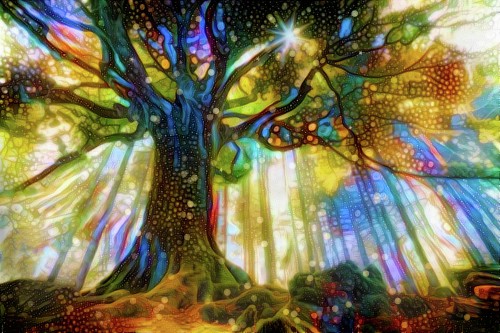
The Art & Words Project was established in 2018 by Zena Shapter.
In 2019 and 2020, it was supported by the Northern Beaches Library Services, Manly Art Gallery & Museum, and Zena Shapter. Together, they produced two printed anthologies, Saltwater and Portrait.
In 2022, the project converted into a national competition with the theme ‘Tree’, this time supported by Zena Shapter and the Northern Beaches Writers’ Group. In 2023, the competition was themed ‘Rain’ and was supported by Zena Shapter, the Northern Beaches Writers’ Group, and the Northern Beaches Council. In 2024, the competition was themed ‘Glass’ and was supported by Zena Shapter and the Northern Beaches Writers’ Group.
From 2025, due to lack of local funding, the competition became available only to current members of the group.